35
Thick,
long beak
Elongated beak for
reaching buried food
Sensitive
tip detects
buried animals
Snipe
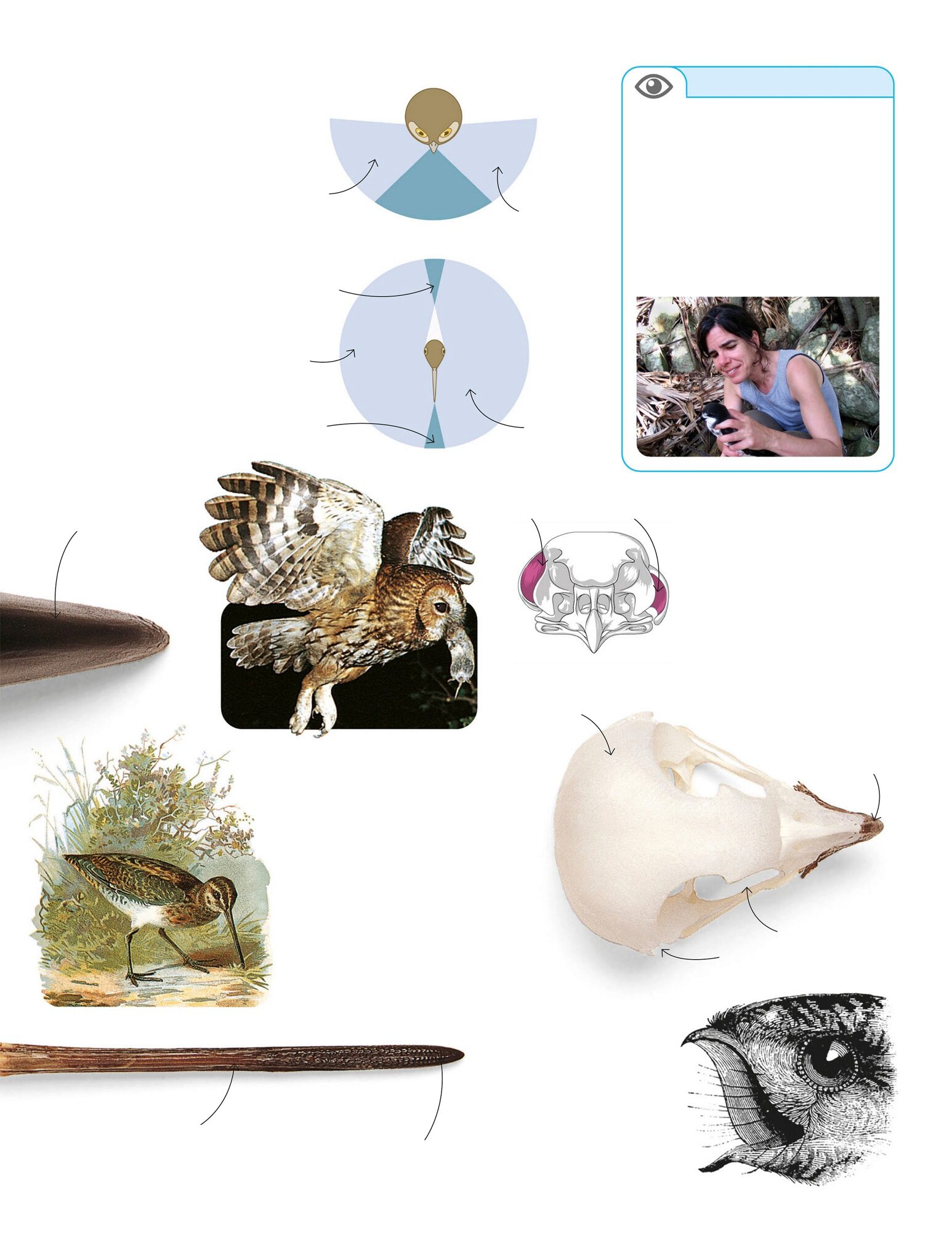
Sensitive beaks
Long-billed birds such as the
snipe have sensitive receptors
on the tip of the beak. When a
wading bird probes into deep
mud with its beak, it can actually
feel what is below it.
Feeling for food
Nightjars have bristles at
either side of their
mouths, which may help
them to feel for food.
Forward-pointing
eye socket for
binocular vision
Owl skull
Ear
cavity
Cranium
The ears
Owls hunt by night. For this
reason, an owl needs acute vision
and hearing. Their left and right
ears are often at different levels
in the skull. Each ear catches a
sound at a slightly different
time, giving improved “binaural”
hearing, which the owl uses to
pinpoint its prey.
Hooked
beak
Owl skull
Hunting in darkness
Some owls hunt in complete
darkness, using their ears
to locate prey.
Higher
ear cavity
Lower ear
cavity
Forward
binocular vision
Monocular
vision
Monocular
vision
Wader
Rear binocular
vision allows bird
to see enemies
approaching
from behind
Bird vision
Most hunting birds can
assess distances with great
accuracy. Owls’ eyes point
almost directly forward,
giving a wide field of
binocular vision. Although
they cannot swivel their
eyeballs, they can turn
their necks to point
backwards. Birds that are
themselves hunted tend
to have eyes that point in
opposite directions. Most
waders, for example, have
sideways-facing eyes,
which allows them a view
of 360 degrees.
Monocular
vision
Owl
Monocular
vision
Binocular
vision
Gabrielle Nevitt
US ecologist Dr Gabrielle Nevitt’s
research focuses on marine animals
including seabirds such as petrels.
She analyses them to understand
how these birds use their sense of
smell to find food in the ocean as well
as tell each other apart in crowded
breeding colonies.
EYEWITNESS